A baby sees for the first time, a mother cries, and nobody checks if it’s real

“Without facts, you can’t have truth. Without truth, you can’t have trust.” Maria Ressa, Filipino-American journalist, and winner of the 2021 Nobel Peace Prize for her work on press freedom and disinformation.
Tricked by the Tick
It takes remarkably little to make an entire audience believe something is real. Not evidence, not verification, just a familiar face reacting to it as though it were true.
When Taylor Swift’s likeness was used, without her knowledge or consent, to front a fake Le Creuset giveaway in 2023, the scam didn’t need her to say a single word. It only needed her credibility, borrowed and recreated by AI, to be convincing. That same trick is at play here: borrowed trust replaces verification every time a public figure or influencer reacts to/shares something online without vetting it first. It’s negligence disguised as a heart emoji, a comment, or a like. Something small enough and seemingly harmless is enough to fool an audience already primed to believe anything with the same weight as a holy text.
I was sent a video of a baby fitted with his first pair of glasses, and looking up, he sees his mother’s face clearly for the first time and reaches for her nose.
She cries, the doctors cry, we cry.
It’s a heartwarming and beautiful story. It has also been circulating online in one form or another since at least 2015: re-cut, re-captioned, and now increasingly reconstructed by generative AI models that have learned exactly which frames make a stranger’s chest tighten.
Search “baby sees for the first time” and you will find countless videos competing for the same reaction: the reflexive urge to repost before you have even finished watching. Some call it clickbait, but who cares? It might just be an accurate formula to make millions.
A recent version posted by a French language account racked up 232,000 likes and 1,800 comments within three weeks. Among the replies sits a verified account belonging to an Oscar-winning actress, and her response?
“My heart!!! ❤️❤️❤️”
Three heart emojis, tens of millions of followers, and not a flicker of doubt about the authenticity of the video. On close inspection, several tells common to AI-generated footage are visible in the clip for those interested. The slightly wrong physics of the mother’s hair, the glasses that never quite sit where a real pair would, the compressed, too-smooth skin tones that generative video models still struggle to shake, and of course, the doctors hand reaching through the mother’s face to put the glasses on the child.
None of that mattered to the audience the comment reached, no alarm bells rang, and nobody thought to verify the video. Why would they when a celebrity has already vetted the video?
Same bias, different applications
Robert Cialdini wrote about and identified mechanisms way before generative video existed, and they apply today as much as they did back then.
Social proof says we look to others, particularly people like us or people we admire, to work out how to feel about something uncertain.
Authority bias says we defer to people who appear to hold status, expertise, or credibility, often without checking whether that status is relevant, in other words, nobody should or would take medical advice from Homer Simpson.
An actress has no more ability to detect a real or fake video than anyone else scrolling at midnight. But her comment does not read as an opinion on video authenticity, it reads as confirmation that this is real and worth feeling something about, and that confirmation travels through her network at a speed no fact check can match.
This is precisely the mechanism that Vosoughi, Roy and Aral, published in their landmark study “The spread of true and false news online”, which found that false stories on Twitter spread significantly farther, faster, deeper, and more broadly than true ones across every category examined, with the most viral false cascades reaching audiences ten to a hundred times larger than typical true stories. Emotional novelty, not accuracy, drove the difference. A crying mother and a baby who can finally see her face will trump any explanation of why the Earth is NOT FLAT.
The scale problem is not slowing down
The numbers on synthetic media are moving astronomically in one direction. Gartner’s AI Risk Management Survey found that 62% of organisations experienced a deepfake-related incident in the prior twelve months, and the World Economic Forum’s Global Risks Report 2025, drawing on more than 900 experts and industry leaders, ranked misinformation and disinformation as the top short term global risk facing society.
Pew Research Centre reported in October 2025 that 51% of Americans now find it difficult to determine what is true online. Ofcom’s research found that two in five UK adults had encountered at least one deepfake in a six-month period, while only one in ten felt confident they could identify one when they saw it. The Reuters Institute’s Digital News Report 2026, drawing on nearly 100,000 respondents across 48 markets, found that 77% of people in the UK are now worried about misinformation, among the highest figures recorded anywhere, and that concern about fake news rose across Western Europe generally, with some of the sharpest increases recorded in the Netherlands, Belgium, and Norway.
None of this requires malicious intent from the celebrity or the account reposting the clip. It only requires an audience primed to trust a familiar face, and an algorithm rewarded for whatever keeps people watching. Alchemists have spent centuries failing to turn lead into gold, and it turns out that the formula is a baby, a pair of glasses, and a crying mother.
The Taylor Swift Le Creuset case, reported by CBS News, is a sharper example of the same dynamic, but with deliberate intent. AI-generated video ads used her image, with no involvement from her whatsoever, to convince fans a fake giveaway was genuine.
The “bunnies on a trampoline” clip that fooled millions in 2025, later debunked, showed how fake videos can pass as real when they arrive without friction, context, or the sceptical instinct to verify first before believing it.
When you have a million followers, thinking twice isn’t optional
The Standard Influencer Tier Classification System (SITCS) is an informal attempt to classify followers into tiers:
Nano: 1,000 to 10,000 followers
Micro: 10,000 to 100,000 followers
Macro: 100,000 to 1 million followers
Mega / celebrity: Over 1 million followers
Celebrities and influencers aren’t the villains of this story, and most of these comments aren’t calculated or malicious. They’re reflexive, emotional, probably typed without a second thought. Social media is a platform for humans, and we are all susceptible to these vulnerabilities. However, intent doesn’t matter here, impact does.
When an account with real reach engages with something unverified, that engagement tells the algorithm it’s worth pushing and tells the audience it’s worth believing, regardless of what the person behind the account meant by it.
The truth about large social media platforms online is that the bigger the following, the more responsibility you have to pause before you react.
We are not asking celebrities and influencers to start critically analysing videos before they hit like or share. What we are asking them is to treat public engagement the way any organisation would: pause, verify and consider the implications before anything is shared or commented on.
A financial institution wouldn’t let anyone reply to a customer complaint without a second look first. Anyone whose reaction can reach seven figures is arguably held to the same standard, whether they’ve agreed to it or not.
What does this mean for the rest of us?
We are as responsible as celebrities and influencers when it comes to liking, sharing, and commenting on posts, especially when the content is fake or contains disinformation, and the habits that catch us in social engineering and phishing scams are exactly the same ones that catch us on social media platforms and in the text messages we share with each other every day.
This should come as an uncomfortable feeling once you realise that the trick in that comment section is not a new one, it’s the same trick a phishing email uses when it borrows a familiar logo, the same trick a fake WhatsApp message uses when it borrows your CEO’s name, and the same trick a scam call uses when it borrows a police officer’s tone of voice, urgency, authority, and emotion, wearing a different disguise each time but trying to trick you all the same. Cybercriminals didn’t invent this, they just noticed it works and started using it on purpose, and now the same mechanisms are being used by people chasing more likes, growing a following, borrowing celebrity fame to endorse products without consent, or reaching for a baby’s face and a meme to trick you all over again.
It might look a lot less harmful, but the World Economic Forum didn’t rank misinformation as the single biggest short-term risk facing the world because of phishing emails alone. It got there because of exactly this, a comment, a like, a share, repeated billions of times a day, sometimes by Celebrities, doing quieter damage than a scam call but doing it at a scale no phishing campaign could ever reach.
My advice, pause before reacting to anything that feels like it was made to elicit an emotional response. Check whether the account posting has a pattern of similar content rather than a single genuine post, and treat a public figure’s reaction as an indication about their feed, not a sign that the content is authentic.
Our S.T.O.P. framework exists precisely for moments like this, the ones where a video is compelling enough that stopping to think feels like the least natural thing to do. We built it for phishing emails, fake invoices, and social engineering, but it works just as well on a crying mother and a pair of glasses, because it’s catching the same reflex, not a different one. Take a moment to think about things in the bigger context, if you get comfortable falling for fake memes and disinformation online, that same habit follows you to work, and could just as easily makes you fall for the next phishing email or social engineering attempt too. Practise your resilience at every opportunity you get.
The baby in that video may be real, AI-generated, or an edited version of someone else’s baby, but the feeling people feel watching him try on his glasses is real, every bit as real as the one that made Taylor Swift’s fans hand over their money for fancy pots and pans that never existed. The formula doesn’t care whether it’s selling you a scam or a share. Neither do the people using it for fraud and disinformation. I’m betting that you do, and that you don’t want to be indirectly responsible for tricking someone else into a poor decision, whether that decision costs them a share, their trust, or their card details.
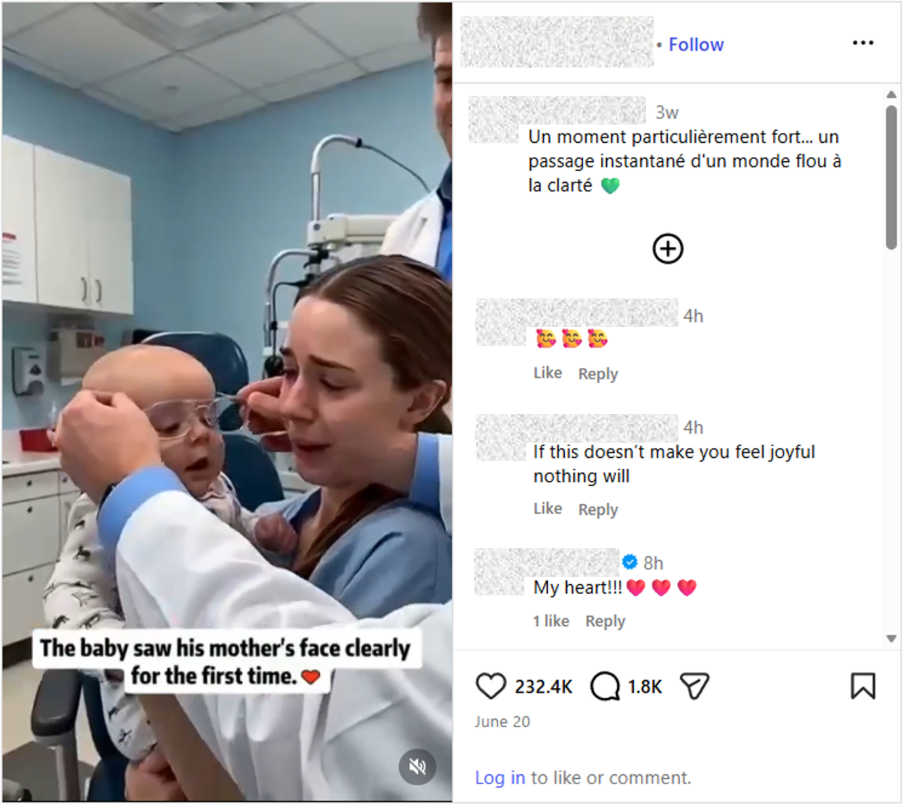
Figure 1– “A baby sees for the first time” Instagram post
Basil Polydorou – Head of Learning Solutions | BsC Cyber Psychology Candidate
References
Cerullo, M. (2024, January 16). AI-generated ads using Taylor Swift’s likeness dupe fans with fake Le Creuset giveaway—CBS News [CBS News]. MoneyWatch. https://www.cbsnews.com/news/taylor-swift-le-creuset-ai-generated-ads/
@CRÈCHEIDOURAR. (2026, June 20). “Un moment particulièrement fort… Un passage instantané d’un monde flou à la clarté 💚” [A particularly powerful moment… An instant shift from a blurry world to clarity] [Instagram Video]. https://www.instagram.com/crecheidourar/reel/DZz8PCbj836/
Cyber Dexterity. (2026, March 6). How Social Engineering Attacks Trick Even Experienced Employees. https://cyberdexterity.com/articles/how-social-engineering-scams-trick-employees/
DHPB. (2024, March 26). The Standard Influencer Tier Classification System (SITCS) (2024). DHPB. https://dhpb.co/sitcs/
Elsne, M., Atkinson, G., & Zahidi, S. (2025). Global Risks Report 2025. World Economic Forum. Retrieved July 14, 2026, from https://www.weforum.org/publications/global-risks-report-2025/
Enterprise Risk Management Research Team. (2025). 3Q25 Emerging Risk Report. Gartner. https://www.gartner.com/en/documents/6982066
Lim, M., Chang, A., & Intagliata, C. (2025, December 17). Simple tricks to spot AI-generated videos in your social media feed. NPR. https://www.npr.org/2025/12/17/nx-s1-5640108/spotting-ai-in-your-feeds
ofcom. (2024, July 23). A deep dive into deepfakes that demean, defraud and disinform [Www.ofcom.org.uk]. https://www.ofcom.org.uk/online-safety/illegal-and-harmful-content/deepfakes-demean-defraud-disinform
Reuters. (2026). Digital News Report 2026. Reuters Institute for the Study of Journalism. https://reutersinstitute.politics.ox.ac.uk/digital-news-report/2026
Vosoughi, S., Roy, D., & Aral, S. (2018). The spread of true and false news online. Science, 359(6380), 1146–1151. https://doi.org/10.1126/science.aap9559
Wang, L., & Haner, J. (2025, October 29). Many Americans say they often come across inaccurate news – and have a hard time knowing what’s true. Pew Research Center. https://www.pewresearch.org/short-reads/2025/10/29/many-americans-say-they-often-come-across-inaccurate-news-and-have-a-hard-time-knowing-whats-true/
WWLTV. (2025, August 3). Viral “Bunnies on a Trampoline” Video Was AI — Here’s How It Fooled Everyone [YouTube]. https://www.youtube.com/watch?v=9O-8kAnBL2s
Yale Law School. (2020, March 3). Maria Ressa Ruminates On the Dangers of Disinformation. Yale Law School. https://law.yale.edu/yls-today/news/maria-ressa-ruminates-dangers-disinformation
Elsner, M., Atkinson, G., & Zahidi, S. (2025). Global Risks Report 2025. World Economic
Forum. https://www.weforum.org/publications/global-risks-report-2025/